
From New York to Hong Kong: What Three-Bedroom City Rents Really Cost

By Rich Arzaga, CFP®, CCIM, The Real Estate Whisperer®
Perspective matters when we talk about rent—especially for people who live in, invest in, or advise clients in major U.S. housing markets.
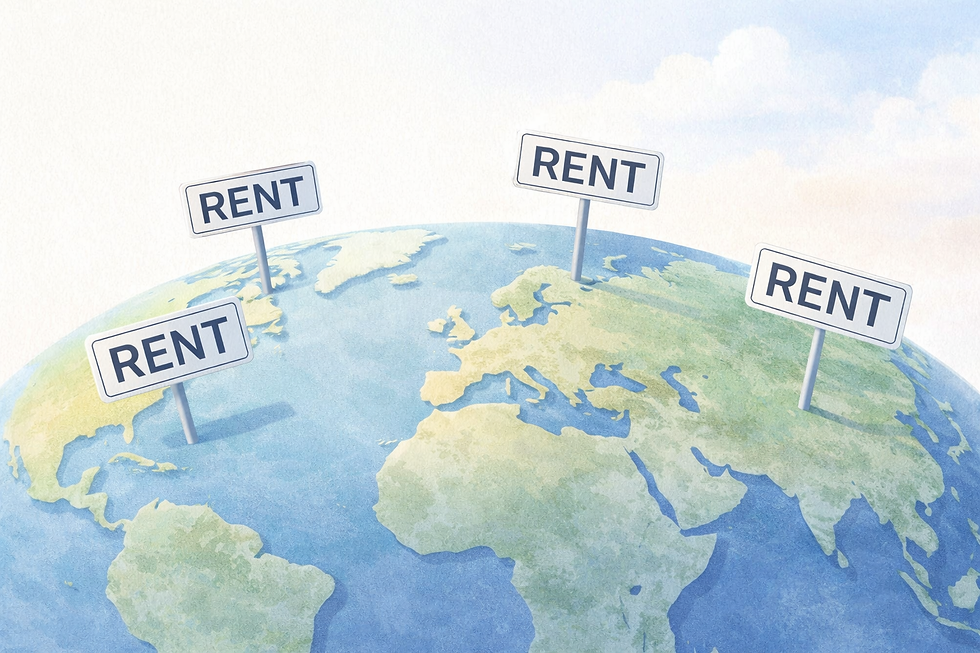
A recently published chart by Visual Capitalist maps monthly rents for three-bedroom apartments in city centers around the world. It’s a powerful snapshot of how expensive urban living has become—and how dramatically costs vary by location.
Data credit: Chart and analysis are based on work by Visual Capitalist, using data sourced via Deutsche Bank.(This blog adds interpretation and planning context; the underlying visualization belongs to them.)

What Exactly Is Being Measured (and What Is Not)
Before comparing numbers, it’s important to clarify the scope. The rentals we are talking about are three-bedroom apartments located in city centers. These rentals are not single-family homes, and not about suburban or ex-urban rentals
In most global city centers, single-family detached homes are rare or nonexistent, so apartments are the appropriate property type for comparison. In many U.S. markets, this differs from how investors and tenants typically think about “three-bedroom rentals,” which are often single-family homes located outside the city center.
This distinction matters—and we’ll return to it.
The Global High-Water Mark: New York
At the top of the list sits New York City, with an average monthly rent of $8,388 for a three-bedroom apartment in the city center.
That number is striking even by global standards—and especially eye-opening for U.S. readers who may already consider New York expensive.
To put that in perspective:
Annualized rent: ~$100,600
This is apartment living, not a townhouse or single-family home
These units are typically condos or large rental buildings, often with amenities and professional management
A U.S. Reality Check: Domestic Comparisons
Several major U.S. cities cluster near the top of the rankings:
Boston – $6,091
San Francisco – $5,424
Chicago – $4,683
Los Angeles – $4,462
For readers in or near these markets, the comparison becomes personal:
“What does a three-bedroom apartment in my city center cost—and how does that compare to what tenants pay today in marjor markets near me?”
In many cases, investors who own single-family rentals outside the core may see lower nominal rents, but also lower acquisition costs per unit—a key distinction when evaluating returns.
International Contrast: Singapore, London, and Hong Kong
Looking beyond the U.S., three global cities stand out:
Singapore – $6,216
London – $5,560
Hong Kong – $4,807
Why this matters:
These cities are dense, global financial hubs
Homeownership rates are often lower
Apartments dominate the housing stock
Regulatory, land-use, and supply constraints are severe
Despite eye-popping rents, ownership costs—including acquisition price, taxes, maintenance, and financing—are also extremely high.
Investor Perspective: High Rents ≠ High Returns
This is the part many investors miss.
While it’s tempting to look at $6,000–$8,000 monthly rents and think “That’s what I want to charge,” the reality is more nuanced.
In most of these global city centers:
Property values are disproportionately high relative to rent
Price-to-rent ratios are often stretched
Net yields can be compressed, not enhanced
Regulatory and operational risks are higher
In other words:
High rent levels often reflect high ownership costs—not outsized investment returns.
This is why many successful real estate investors operate outside global city cores, where:
Acquisition prices are lower
Rent-to-price ratios are more favorable
Cash flow is easier to engineer
Exit options remain flexible
Frequently Asked Questions
Why is New York the most expensive city for three-bedroom apartment rents?
New York combines global demand, limited supply, strict zoning, and high-income employment—all concentrated in dense city centers.
Are these rents comparable to U.S. single-family rentals?
No. These figures reflect apartments in city centers, not detached homes. Single-family rentals in U.S. suburbs are a distinct investment property type.
Do higher rents mean better investment performance?
Not necessarily. High rents often coincide with very high property values, which can reduce yield and cash-flow efficiency.
Why don’t city centers have many single-family homes?
Land scarcity, zoning history, and urban density favor vertical housing. Apartments are the dominant form of housing in global cores.
The Bigger Takeaway
This map isn’t just about rent—it’s about context.
For tenants, it highlights affordability pressures. For planners and advisors, it reframes housing choices. For investors, it’s a reminder that headline rent numbers don’t tell the whole story.
Understanding what kind of property, where it’s located, and what it costs to own is far more important than chasing the highest rent on paper.
Written by Rich Arzaga, CFP®, CCIM, Founder, The Real Estate Whisperer® Financial Planning. Helping clients and advisors integrate real estate into holistic financial plans.
##GlobalHousing
#Keystone Wealth Counsel


Comments